


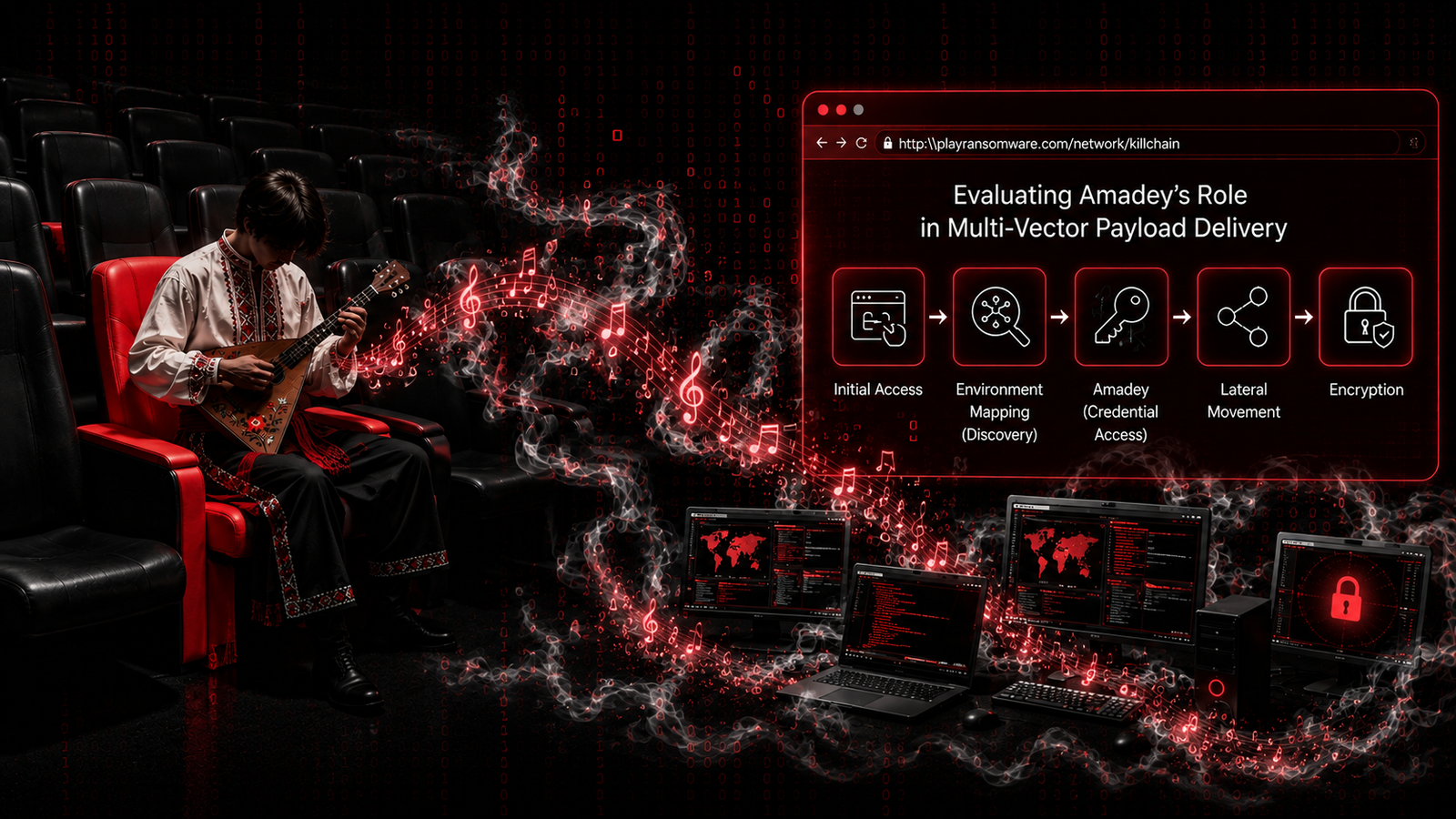
A single file hash served as a digital keyhole, exposing the infrastructure and operational playbook behind the Play Ransomware campaign. Our analysis traces the intrusion chain from an Amadey-based loader through to ransomware deployment, revealing deliberate operational trade craft including a built-in Geo fencing mechanism that causes the malware to self-terminate on systems configured with Russian, Ukrainian, or Belarusian language settings, indicating the actor's intent to avoid CIS regions while targeting Western enterprises.
The investigation further identified the Cobalt Strike and Sliver C2 infrastructure used to support lateral movement and payload delivery, providing defenders with actionable indicators of compromise. In parallel, we tracked the group's activity on the dark web, offering additional visibility into their operations. Most significantly, our forensic analysis surfaced a singular, persistent digital artifact that inadvertently exposes insight into the threat actor's true origin, a finding detailed in the full report.
Play Ransomware Overview
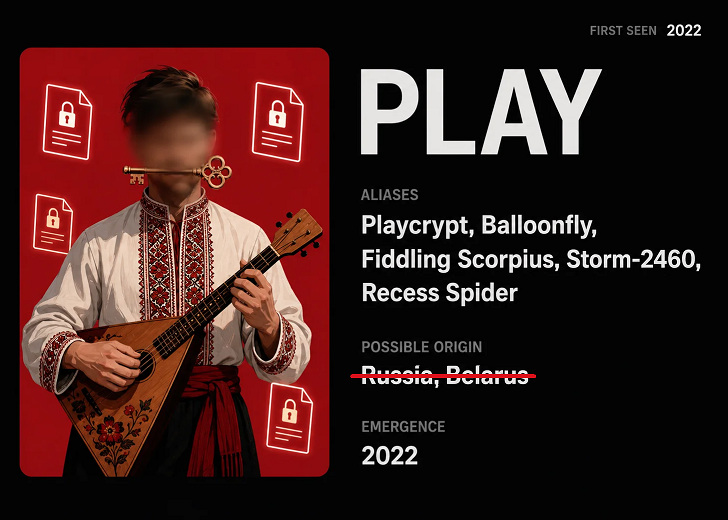
Play, also known as PlayCrypt, has been running since June 2022 and shows no sign of slowing down. Between 6 and 9 August 2026 the group posted six organisations to its leak site: Marconi Industrial Services, Rilpa Enterprises, MIE Solutions, GCATS Investments, Signature Services and Platinum Group. That brings its tracked total to roughly 1,300 incidents. Victims cluster in mid-market manufacturing, industrial services, engineering and professional services, and are overwhelmingly headquartered in North America. We assess severity as high. Play-linked operators deployed a zero-day for CVE-2025-29824 in the Windows CLFS driver before Microsoft patched it in April 2025, they recompile the encryptor for every intrusion so no two victims see the same hash, and they run custom tooling such as the Grixba scanner and a Volume Shadow Copy file-copying utility alongside an initial-access relationship with the North Korean group Andariel. The detail that matters most for leadership is the sequencing. Play steals data first and extorts second, which means declining to pay does not close the exposure. Once files are published, the names, emails, phone numbers and addresses inside them get scraped into the same broker and dump ecosystem that doxxers and social engineers already work from, leaving employees and customers exposed long after the network itself is restored. Treat this as an exposure and identity problem rather than a malware problem: close off internet-facing RDP, VPN, FortiOS and Exchange, enforce phishing-resistant MFA, and plan for data-exposure liability separately from any recovery decision.
| Designation | Assigned By | Refers To |
|---|---|---|
| Play/PlayCrypt | Community adoption, Malpedia | The ransomware family |
| Balloonfly | Symantec | The group that develops and deploys Play |
| Fiddling Scorpius | Palo Alto Unit 42 | The Play operation |
| Storm-2460 | Microsoft | CLFS zero-day and PipeMagic cluster, associated with Play by third parties but not by Microsoft |
| Recess Spider | Crowdstrike | The Play Operation |
Attribution is best expressed at three separate levels rather than as one figure.
Malware to operation: high. The Play family maps cleanly to a single operation with consistent tooling, a consistent staging path, and a single leak site lineage. Symantec, Unit 42, CrowdStrike and CISA converge on the same operational picture.
Operation to nationality: low. No public source in this collection attributes Play to a named nation or to named individuals. Ransom note contact addresses ending in gmx[.]de and web[.]de are an operational choice, not an origin indicator, and should not be read as such.
Operation to the wider ecosystem: medium. The links to ShadowSyndicate, Andariel and QuadSwitcher are documented but characterised by their own authors with hedged language, which is reproduced below rather than flattened.
MotivationFinancial, with no observed espionage collection objective. The operation runs double extortion throughout. Data is stolen and published on a leak site when the ransom is not paid.
This is the central unresolved question in Play reporting and should be presented as such. Blackpoint records the operation style as debated, reporting indicates the group likely operates as a RaaS, while the group maintains it is private. Play's own leak site states the operation is closed and designed to guarantee the secrecy of deals, and despite reports that it opened to RaaS in late 2023, the site carries a statement that the group is private and has no plans to open the operation. Symantec's assessment is consistent: Play does not appear to operate as a RaaS, with Balloonfly seemingly carrying out the attacks as well as developing the malware.
The practical consequence is that observing Play tooling in an intrusion does not establish that Play operators were present. That inference has become unsafe.
ALPHV/BlackCat, LockBit, Play, Royal, Cl0p, Cactus and RansomHub, with Group-IB assessing in 2023 that it is more likely a RaaS affiliate than an initial access broker.As Intrinsec relay it, Play ransomware is only one of the many ransomware brands used by ShadowSyndicate. Chris Duggan reported in October 2024 on an MSI sample overlapping the top tier ransomware ecosystem including Play and Cl0p, possibly via an access broker's ransomware network, and Bitdefender, citing that work, noted that macOS backdoor artifacts and IOCs suggest a possible relationship with the BlackBasta and ALPHV/BlackCat ransomware operators, and thus with North Korean threat actors suspected of usually using Rustdoor.
Cobalt Strike
Cobalt Strike is Play's primary command and control framework and is the thread that ties the group into both the Quantum lineage and the wider criminal tooling economy. Blackpoint list Cobalt Strike under command and control alongside Empire, Sliver and SystemBC, and record the use of Cobalt Strike beacons with HTTPS-based C2 in observed Windows behaviour.
Play is a named beneficiary of cracked Cobalt Strike. Play appears in the referenced family list for the 2023 civil action brought by Microsoft, Fortra and Health-ISAC in the Eastern District of New York, case 1:23-cv-02447, alongside Black Basta, BlackCat, LockBit, Cuba, Emotet, Mount Locker, QakBot, RagnarLocker, Royal and Zloader.
Activity Tracking on Dark Web
Play operates a single data leak site branded PLAY NEWS, reachable at j75o7xvvsm4lpsjhkjvb4wl2q6ajegvabe6oswthuaubbykk4xkzgpid.onion/index.php. The service was confirmed active on 4 August 2026. It runs plain HTTP with no TLS, which is standard for Tor hidden services since the Tor protocol provides transport encryption at the circuit layer.
Four onion addresses are attributable to Play across its operational life. Tracking via ransomware.live and the AIL Framework produces the following timeline.
| Onion Address | Status | First seen | Role |
|---|---|---|---|
| mbrlkbtq5jonaqkurjwmxftytyn2ethqvbxfu4rgjbkkknndqwae6byd.onion | DISABLED | 2023-04-05 | Original DLS |
| k7kg3jqxang3wh7hnmaiokchk7qoebupfgoik6rha6mjpzwupwtj25yd.onion | DISABLED | 2023-05-05 | Secondary/mirror |
| ipi4tiumgzjsym6pyuzrfqrtwskokxokqannmd6sa24shvr7x5kxdvqd.onion | DISABLED | 2024-10-03 | Brief-lived, co-temporal with current |
| j75o7xvvsm4lpsjhkjvb4wl2q6ajegvabe6oswthuaubbykk4xkzgpid.onion | ENABLED | 2024-10-03 | Current active DLS (TARGET) |
Three pages are confirmed. Two were observed directly and one was recovered through a header leak.
/index.php, the victim listing page/contact.php, a submission form/faq.php, recovered from the Referer header of a request to index.php
The presence of faq.php was disclosed not by crawling but by the site's own failure to set a Referrer-Policy header, which is discussed below.
Technical Stack| Component | Evidence | Assessment |
|---|---|---|
| Web Server | Server: nginx response header | Nginx reverse proxy or direct server |
| Backend | PHPSESSID cookie, .php file extensions | PHP application (likely PHP-FPM behind nginx) |
| Content Delivery | Transfer-Encoding: chunked | Dynamic content generation, not static files |
| TLS | None (HTTP only) | Standard for .onion (Tor provides E2E encryption) |
| Session Management | PHP native sessions | PHPSESSID=rn5sd1j6llgok174o35qnj62jh |
The response captured on 4 August 2026 was 163 bytes:
HTTP/1.1 200 OK
Server: nginx
Date: Tue, 04 Aug 2026 08:27:13 GMT
Content-Type: text/html; charset=UTF-8
Transfer-Encoding: chunked
Connection: keep-alive
Server banner. The Server: nginx header identifies the web server software without disclosing a version string. The absence of a version partially mitigates the exposure, but the banner alone narrows the vulnerability surface an adversary or a law enforcement partner would need to consider, and version fingerprinting through behavioural probing (malformed request handling, HTTP/2 negotiation) remains available. For defenders, the more useful application is tracking rather than exploitation: the response header set is stable enough to serve as a fingerprint for identifying Play infrastructure across future onion rotations.
Chunked transfer encoding. Confirms the DLS is a live application performing server-side rendering, not a static page dump. Practically, this means victim listings, view counters and countdown states are generated per request from a backing store, and it complicates content-length-based fingerprinting.
Character set. UTF-8 supports internationalised victim names, consistent with the multi-geography targeting visible in Figure 1.
Missing security headers. No X-Frame-Options, Content-Security-Policy, X-Content-Type-Options, Referrer-Policy or cache directives are set. This is typical of ransomware leak sites, where operators prioritise availability over hardening, but each omission has a specific consequence:
| Missing header | Consequence |
|---|---|
| X-Frame-Options | DLS could be iframed by researchers for monitoring/capture |
| Content-Security-Policy | No XSS mitigation — PHP application potentially vulnerable to reflected/stored XSS |
| X-Content-Type-Options | MIME sniffing attacks possible against DLS users |
| Strict-Transport-Security | N/A for .onion (no TLS), but indicates no HTTPS-first mindset |
| Referrer-Policy | Critical, absence allows the Referer leak observed in request headers |
| Cache-Control / Expires / ETag | No caching directives, DLS content could be cached by Tor circuit nodes |
GET /index.php HTTP/1.1
Host: 0.0.0.0:80
User-Agent: Mozilla/5.0 (Windows NT 10.0; Win64; x64; rv:140.0) Gecko/20100101 Firefox/140.0
Referer: http://j75o7xvvsm4lpsjhkjvb4wl2q6ajegvabe6oswthuaubbykk4xkzgpid.onion/faq.php
Connection: keep-alive
Cookie: PHPSESSID=rn5sd1j6llgok174o35qnj62jh
Upgrade-Insecure-Requests: 1
Sec-GPC: 1
Attribution caveat, and this belongs in the published text. The request headers describe the collecting analyst's browser, not the operators'. The Host: 0.0.0.0:80 binding is a Tor Browser SOCKS proxy artefact. The Firefox 140.0 user agent, the Upgrade-Insecure-Requests flag and the Sec-GPC privacy signal are all client-side configuration on the research side. None of these carry intelligence about Play. Stating this explicitly prevents a reader from misreading the capture as operator fingerprinting.
The Referer leak. The only genuine adversary-side finding in the request set. Because the DLS sets no Referrer-Policy, navigation from the FAQ page to the index page transmitted the full source URL, disclosing /faq.php as a distinct resource. This is a minor but real structural disclosure: it confirms the site is a multi-page application with victim-facing documentation rather than a flat listing, and it demonstrates that passive header collection can enumerate DLS structure without any active crawling. The same technique should be applied systematically across other leak sites during collection.
Session cookie. PHPSESSID is the PHP default name, unchanged, transmitted over plain HTTP with no visible Secure, HttpOnly or SameSite attributes. The operators have not customised PHP session configuration. This is a low-value finding on its own, since Tor provides the transport protection the missing Secure flag would otherwise supply, but combined with the absent CSP it indicates a stock LAMP-style deployment with no application hardening.
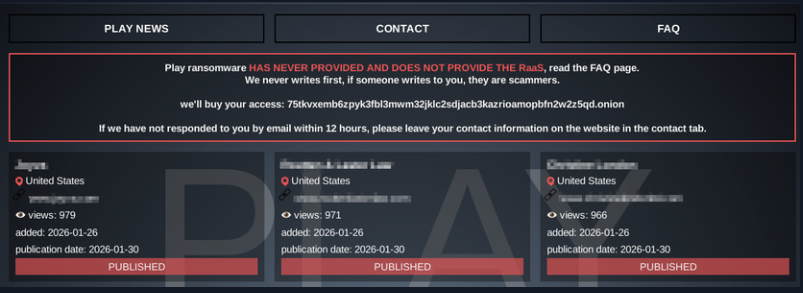
The FAQ sets out a three-stage publication process: posting the organisation with a countdown timer, publication of five gigabytes of personal data, then full publication. Those three stages correspond exactly to the status banners visible on the listing page, where entries read 1 DAY BEFORE PUBLICATION, PUBLISHED, and PUBLISHED FULL. This correspondence is the analytically valuable part of the capture set, because it means the listing page can be parsed to determine precisely where each victim sits in the extortion timeline, and the interval between the added date and the publication date field gives a measurable negotiation window. Across the entries visible in Figure 1 that window runs between four and eight days.
The FAQ also confirms the RaaS position independently of the banner. The group states it is not an affiliate program and frames this as a guarantee of the secrecy of deals with no third parties involved. This is the same claim Symantec and Unit 42 report, now sourced directly from the operators, and it should be presented in the report as the group's assertion rather than as established fact given the QuadSwitcher and DFIR Report findings.
Two further details are worth recording. The contact channel is a webform requiring an email address, a free-text description and a captcha, with the group stating it will never make first contact and that anyone approaching a victim first should be treated as a scammer. The ransom note carries an independent contact address, qadxmkpav8431@gmx.com, consistent with the gmx and web.de pattern documented across Play's operational history.
- Monitor the current endpoint on a fixed cadence and record the
views,addedandpublication datefields per entry. The view counter is a rough proxy for listing age and attention, and the date delta quantifies the negotiation window. - Treat the response header set as a rotation fingerprint. When address 4 is retired, the nginx and chunked-encoding signature plus the absence of security headers gives a candidate-matching heuristic for identifying its replacement.
- Expect a paired deployment at the next rotation. Both previous generations were provisioned as primary plus mirror, so a newly observed Play onion should trigger a search for a co-temporal sibling rather than being treated as a single replacement.
- Archive faq.php and contact.php content at each capture. FAQ text has changed across the group's lifetime and changes to the publication scheme or the RaaS statement would be a meaningful signal about operating model shifts.
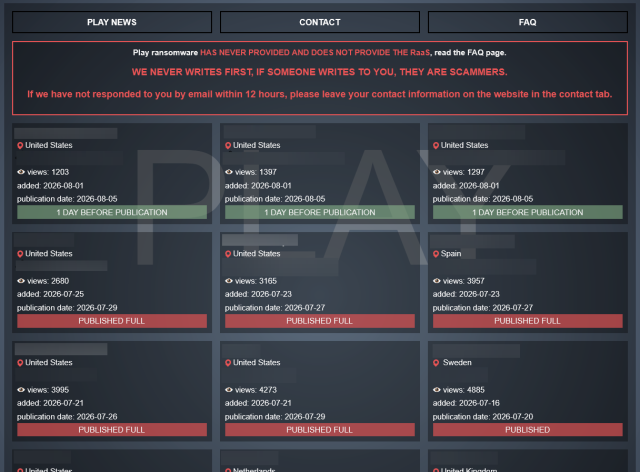
Victim names redacted. The banner states that Play has never provided and does not provide RaaS, and warns that any party making first contact is an impostor. Each entry carries a country field, a view counter, an added date, a scheduled publication date and a status label corresponding to the group's three-stage publication scheme. Countries visible on this page include the United States, Spain, Sweden, the Netherlands and the United Kingdom.
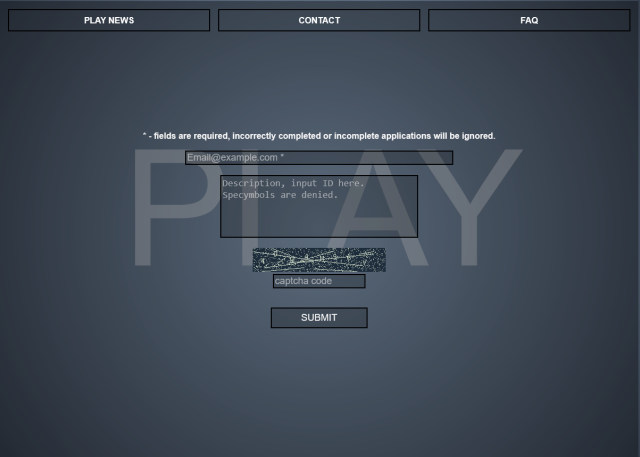
Victims are required to submit an email address, a free-text description containing their input ID, and a captcha response. The note that incomplete or incorrectly completed applications will be ignored, combined with the group's stated refusal to initiate contact, indicates a deliberately controlled intake process consistent with a closed operation.
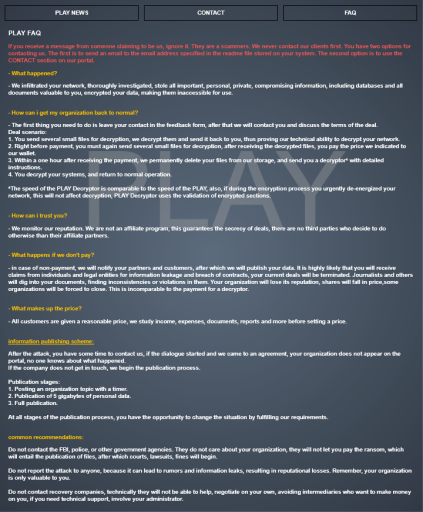
The page documents the group's claim not to operate an affiliate program, its decryption proof process, and a three-stage information publishing scheme comprising timed listing, partial publication of five gigabytes of personal data, and full publication. It also advises victims against contacting law enforcement or recovery firms.
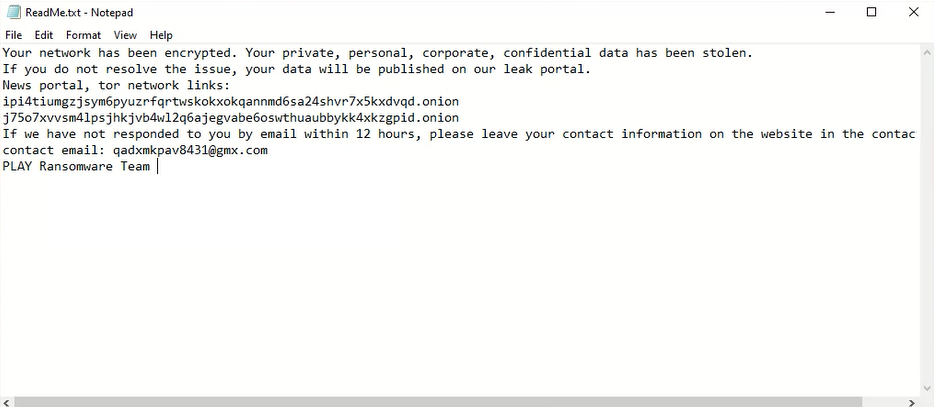
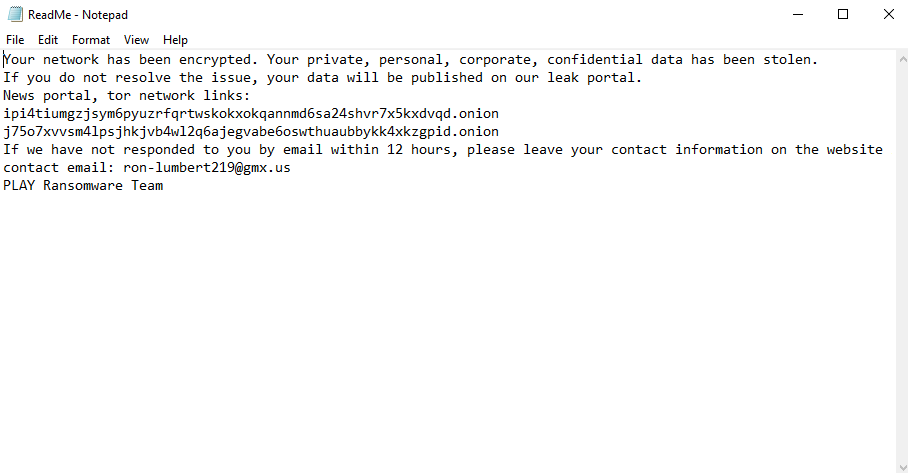
The note confirms the double extortion sequence, stating that data has been stolen and will be published on the leak portal if the issue is not resolved. It lists two onion addresses as news portal links, ipi4tiumgzjsym6pyuzrfqrtwskokxokqannmd6sa24shvr7x5kxdvqd.onion and j75o7xvvsm4lpsjhkjvb4wl2q6ajegvabe6oswthuaubbykk4xkzgpid.onion, evidencing simultaneous primary and mirror deployment rather than sequential replacement. Contact address qadxmkpav8431@gmx.com. Signed PLAY Ransomware Team.
Adversary Infrastructure Hunting

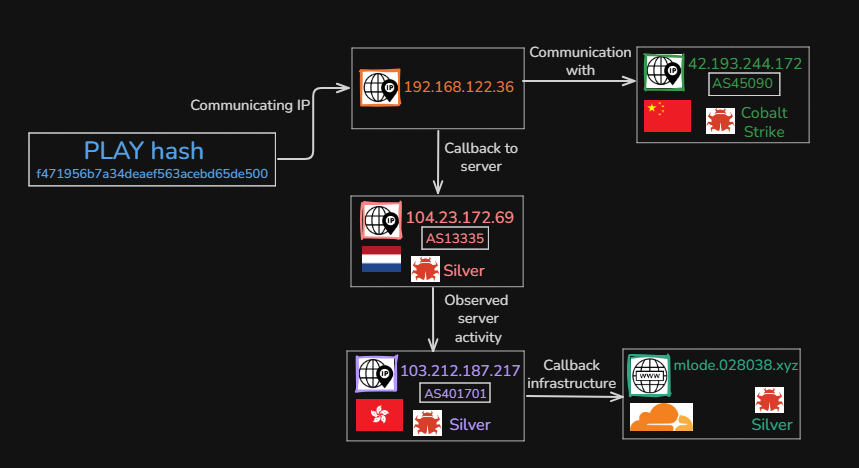
Our starting point is a hash we came across while researching on PLAY, which is: f471956b7a34deaef563acebd65de500. On many threat intelligence platforms it has been explicitly labelled as being part of PLAY Ransomware. We observed a communicating source IP on this hash: 192.168.122.36
Hunt.io code search feature gives us many results as shown below:
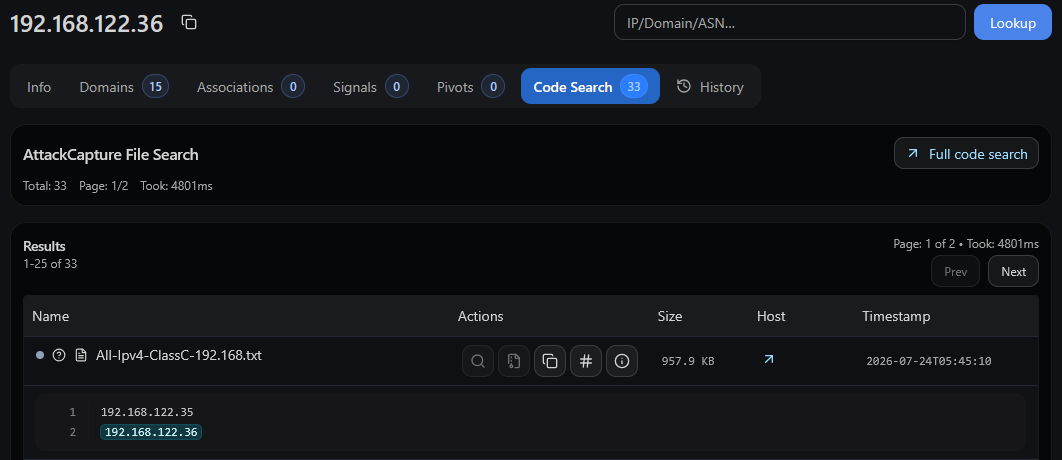
But the most noticeable ones being:
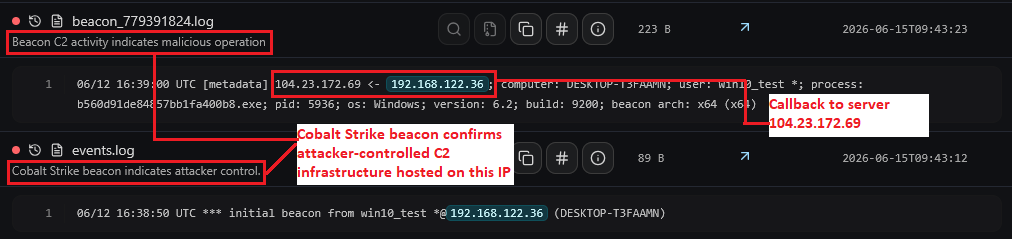
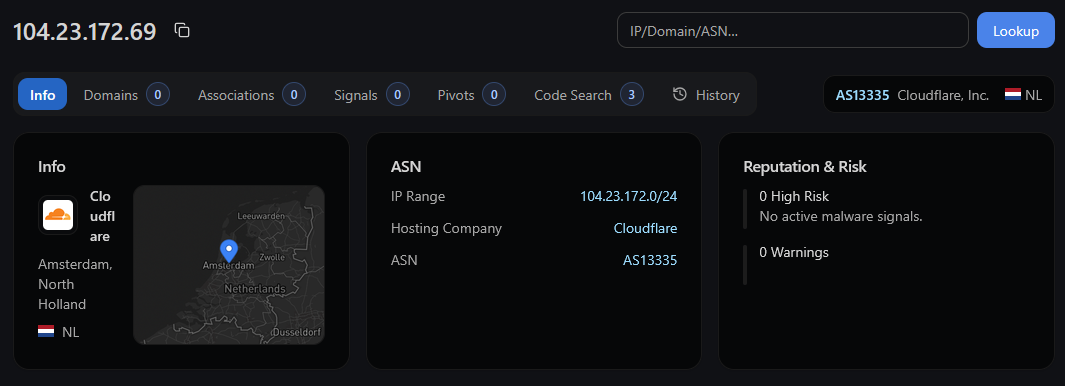
Note the IP 104.23.172.69 to be investigated in the next phase.
If we have a look at some of the information of the files individually, we see:
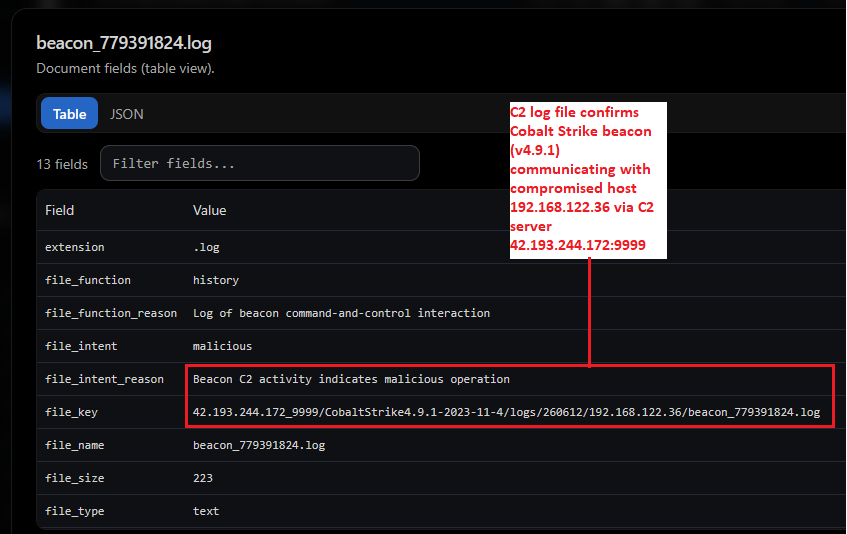
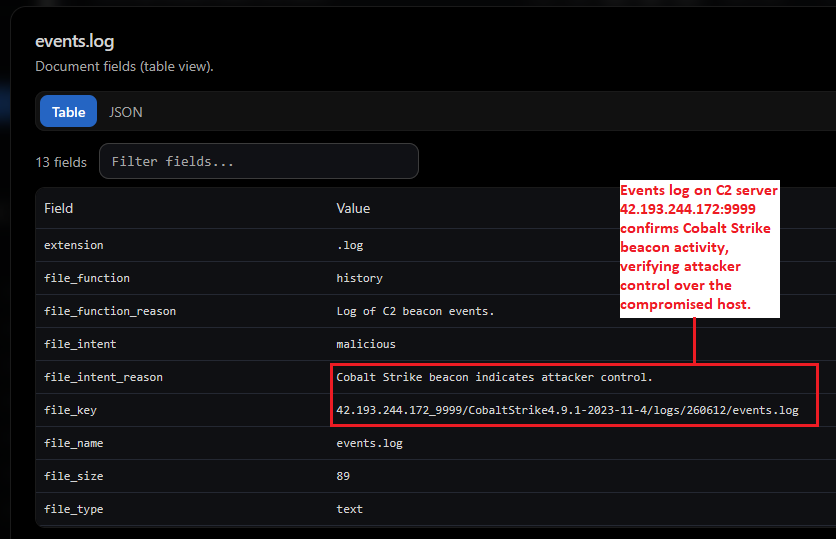
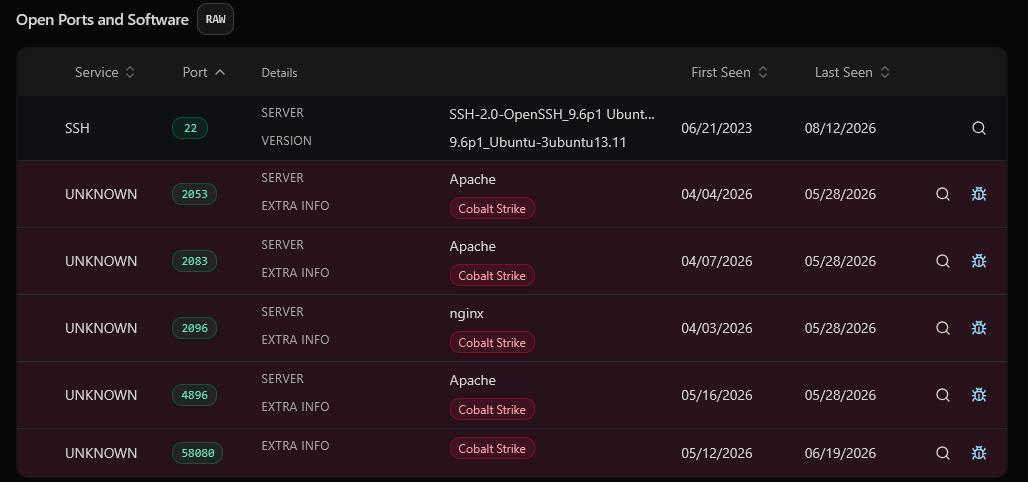
Note the IP 42.193.244.172 to be investigated in the next phase.
As mentioned in the previous sections, PLAY has been known to use cobalt strike, a strong indicator that they’re a part of PLAY’s infrastructure.
Now we come to phase 2 and begin investigating IPs: 104.23.172.69 and 42.193.244.172
When we head over to Hunt.io’s AttackCapture File search feature, we observe:
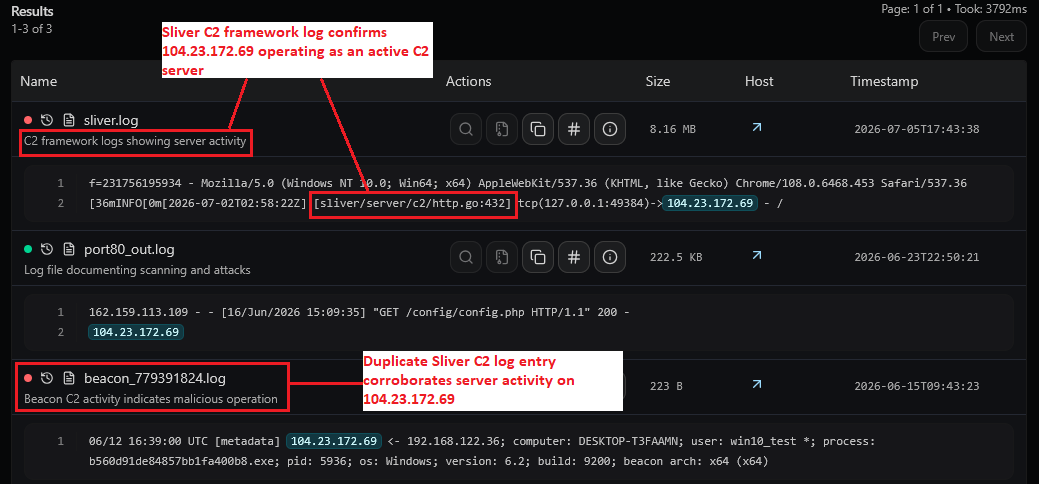
We check silver.log further for more information
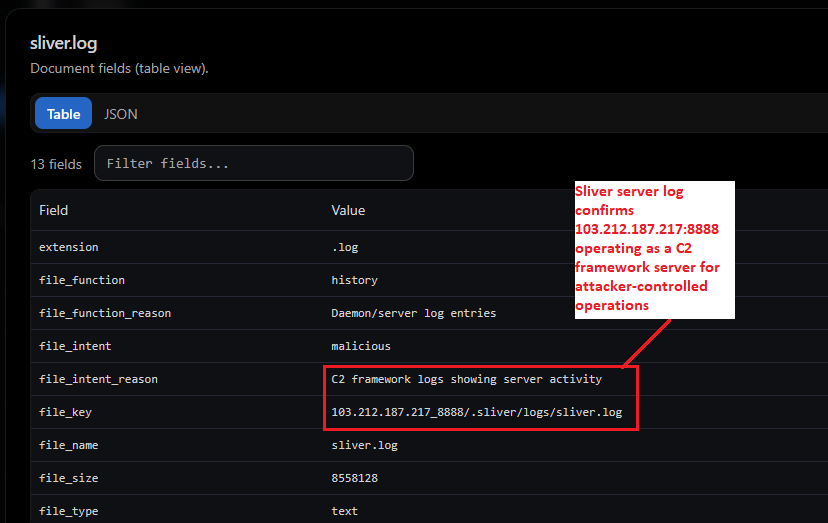
Note IP 103.212.187.217 for the third phase
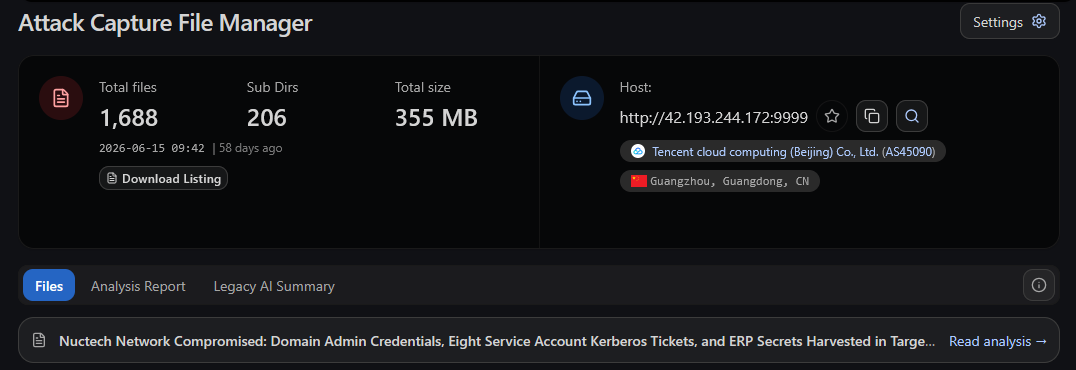
Now coming to IP 42.193.244.172
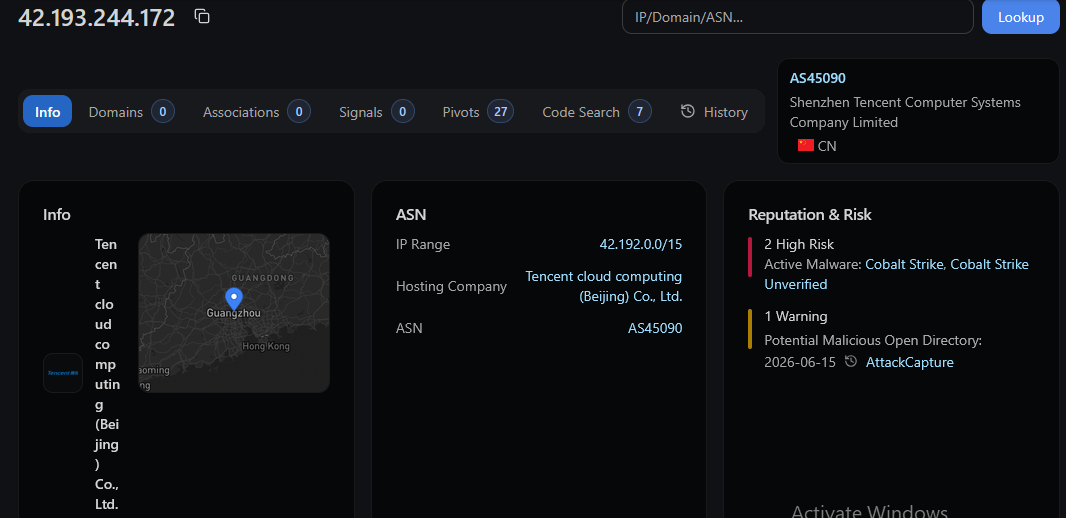
Hunt.io’s AttackCapture file search shows the following files:


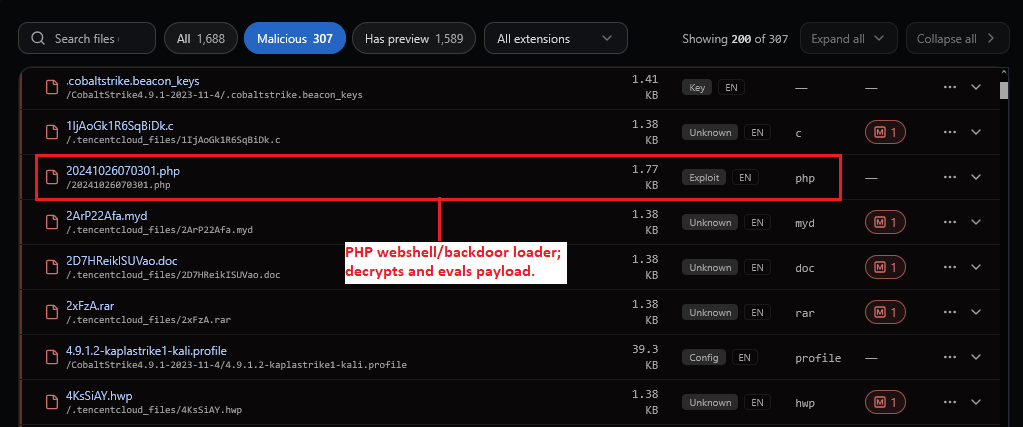
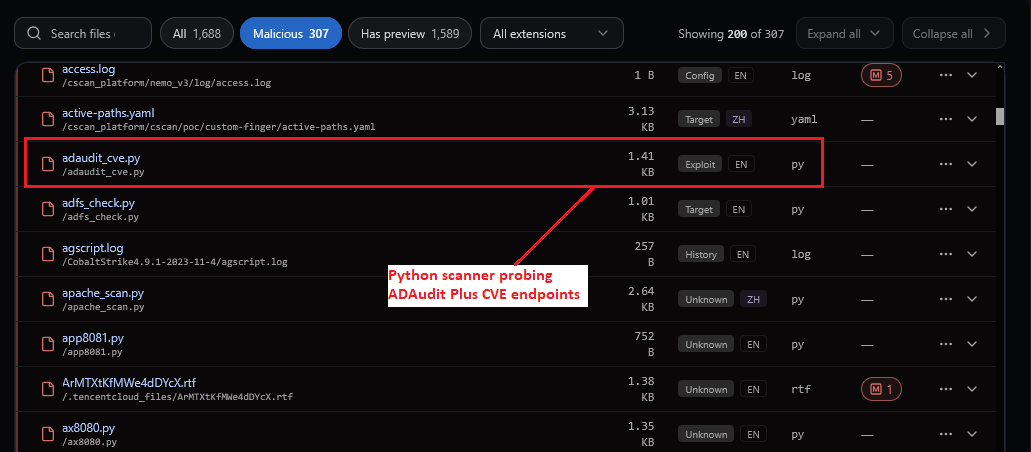
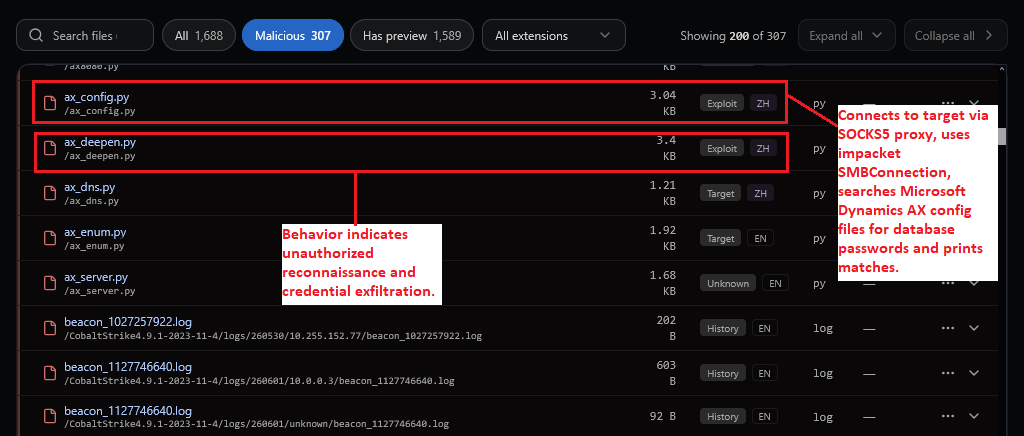
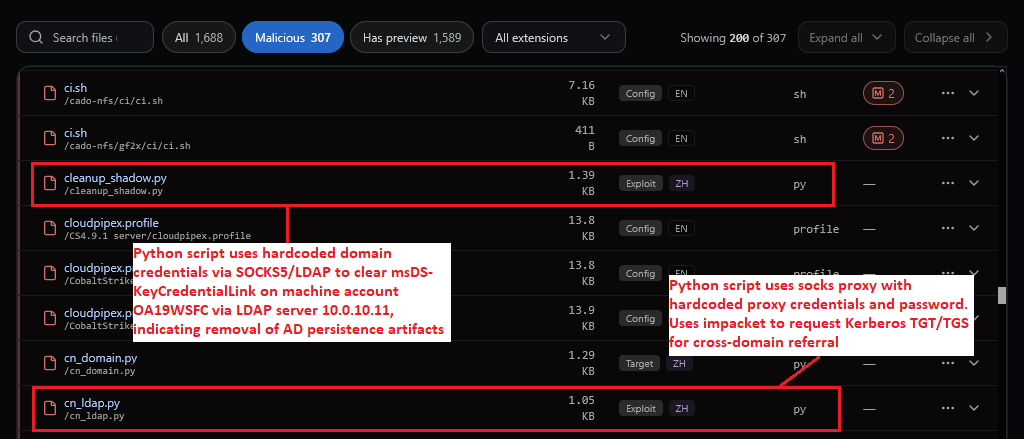
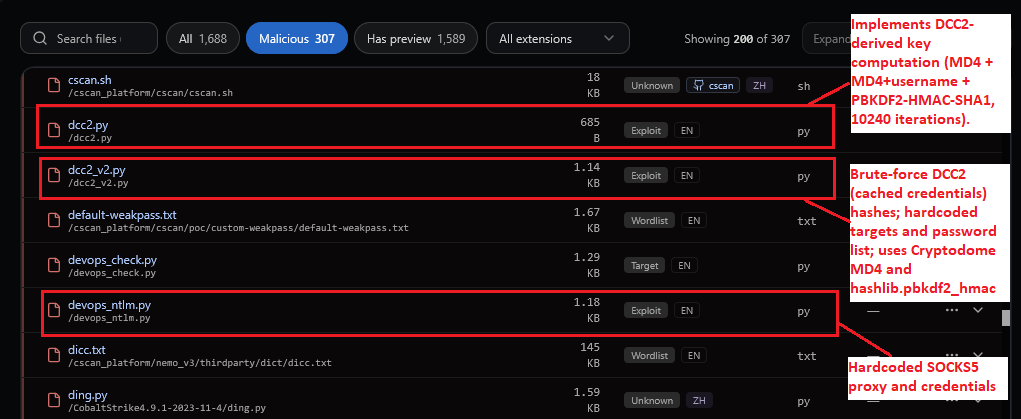
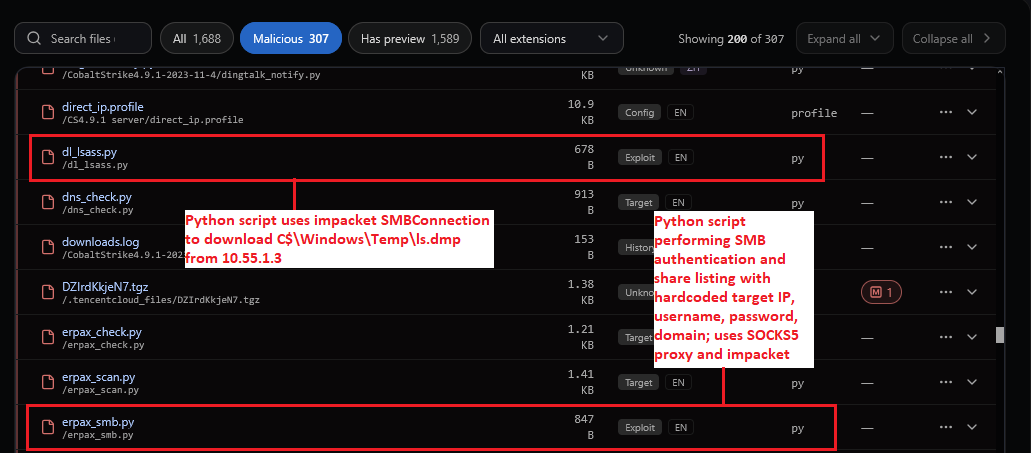
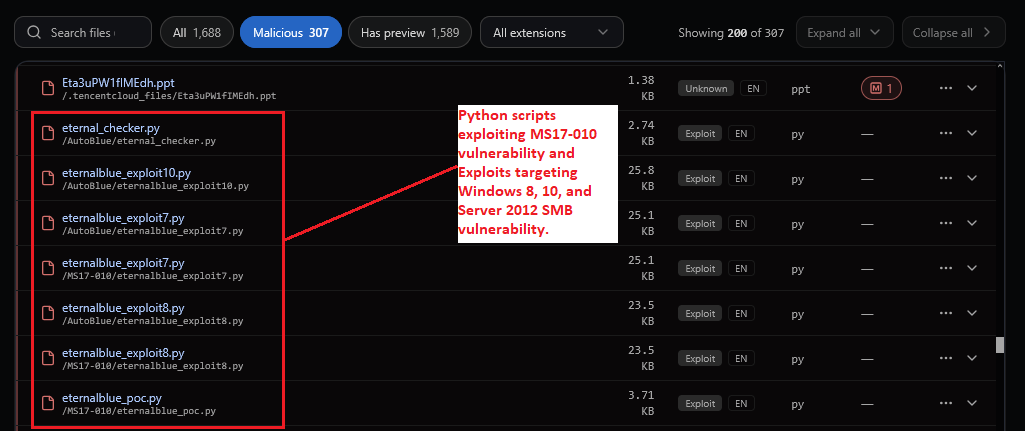
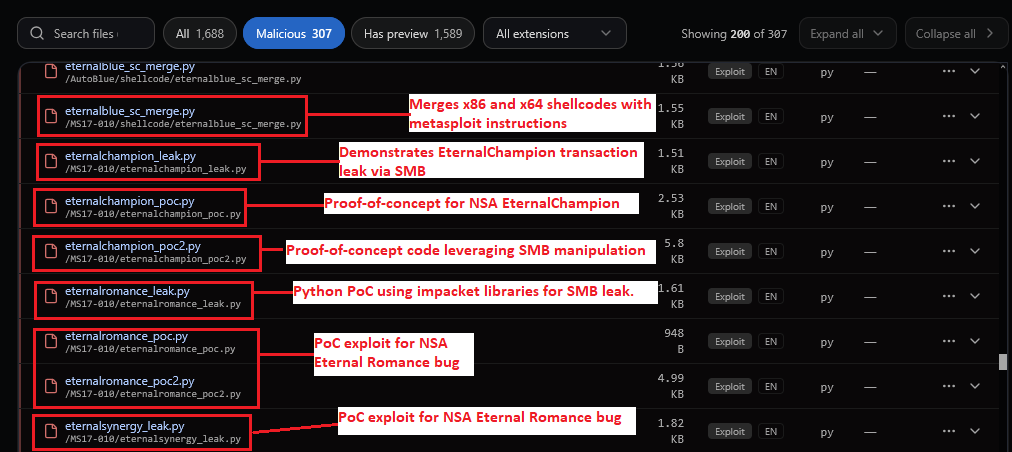
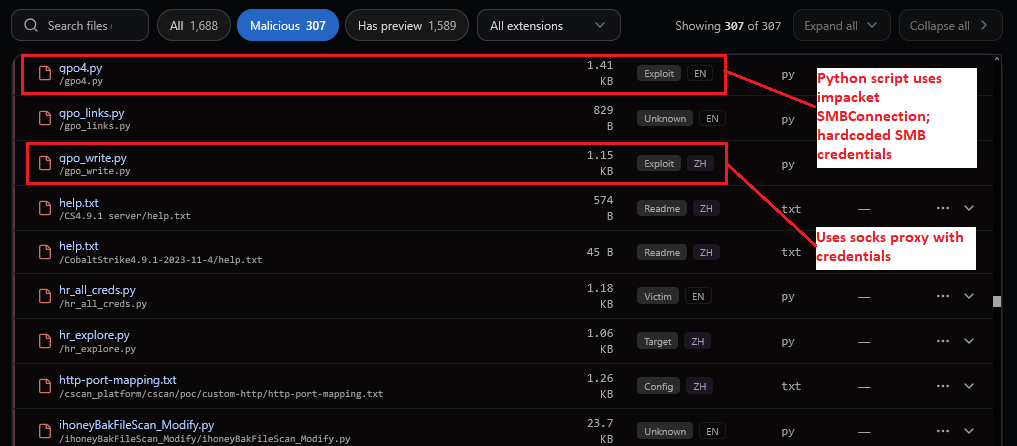
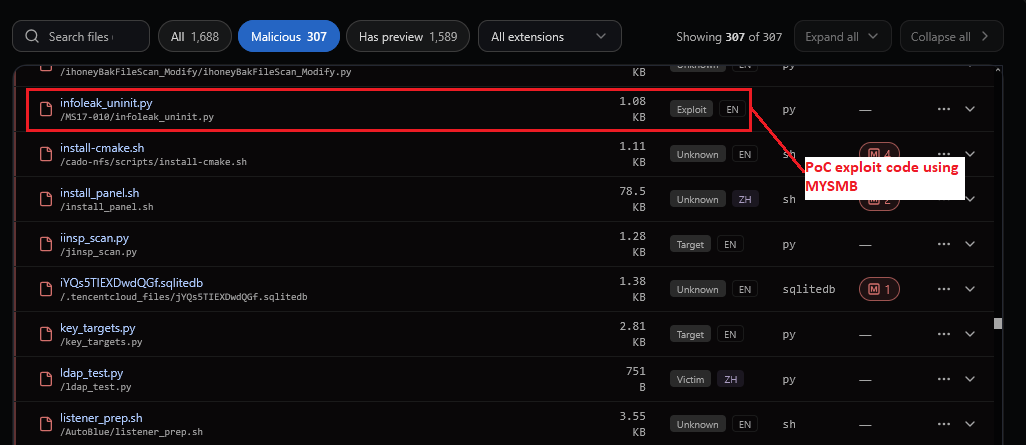
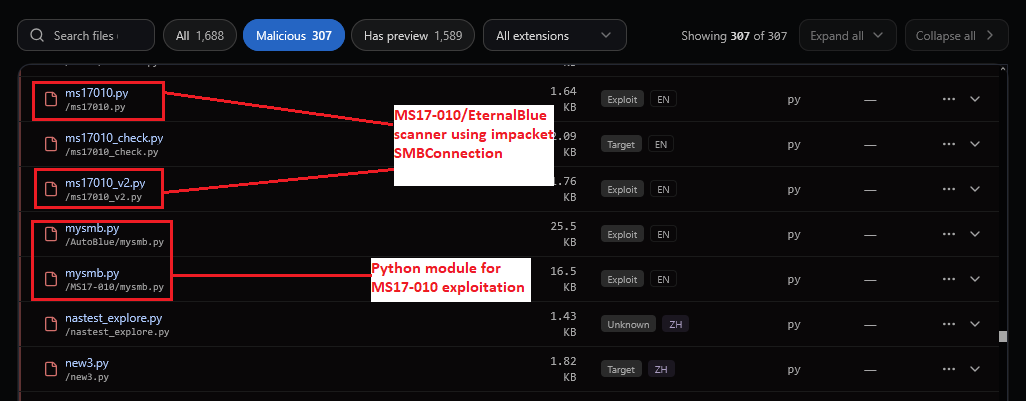
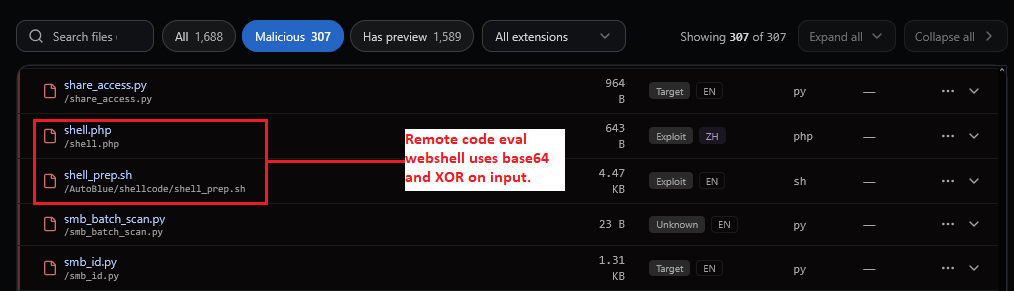
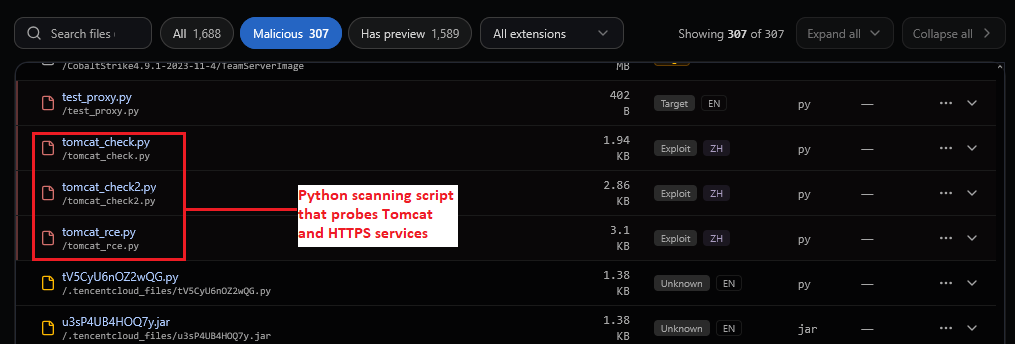
These files contain a range of attacker tooling used for post-exploitation, including a PHP webshell for remote code execution, Python scripts exploiting known vulnerabilities and performing SMB-based reconnaissance and credential harvesting via impacket, scripts using hardcoded credentials and SOCKS5 proxies to access internal hosts, exfiltration of sensitive files (memory dumps, PFX certificates, configuration files containing credentials), and a Cobalt Strike beacon notification script that alerts the attacker via a DingTalk webhook when a compromised host comes online, collectively indicating a multi-stage intrusion involving lateral movement, credential theft, and data exfiltration.
Now coming to phase 3, we investigate 103.212.187.217
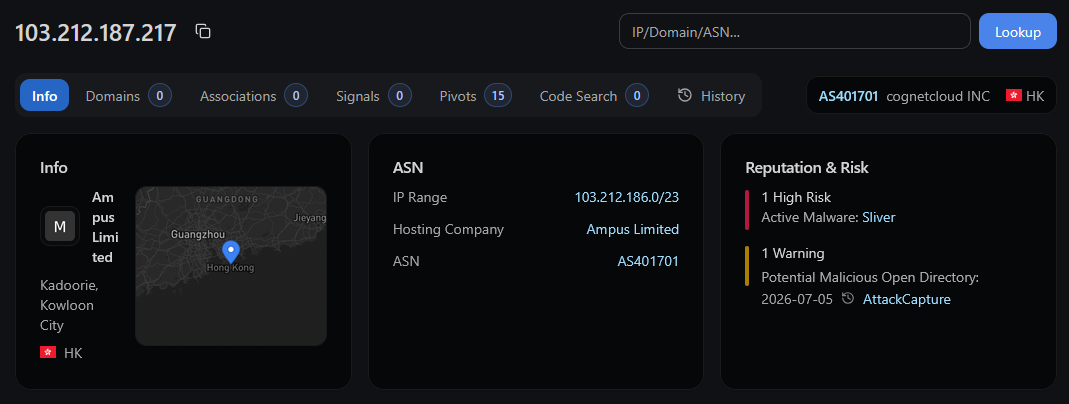

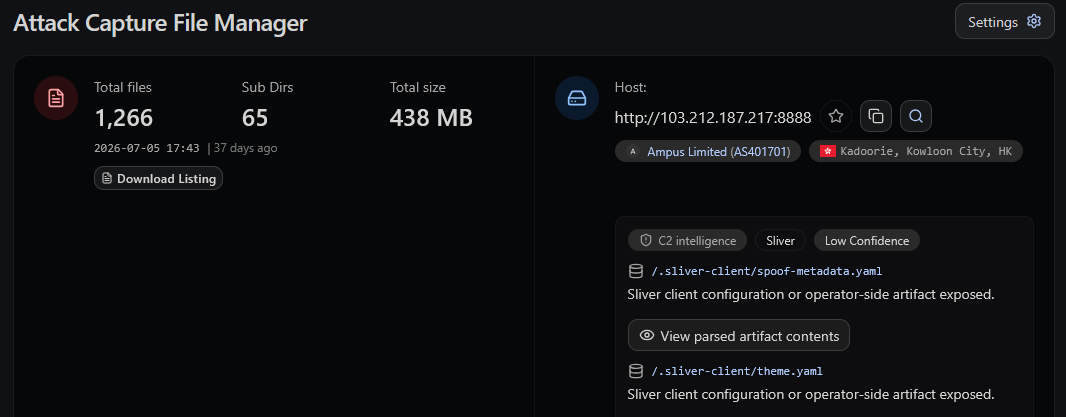
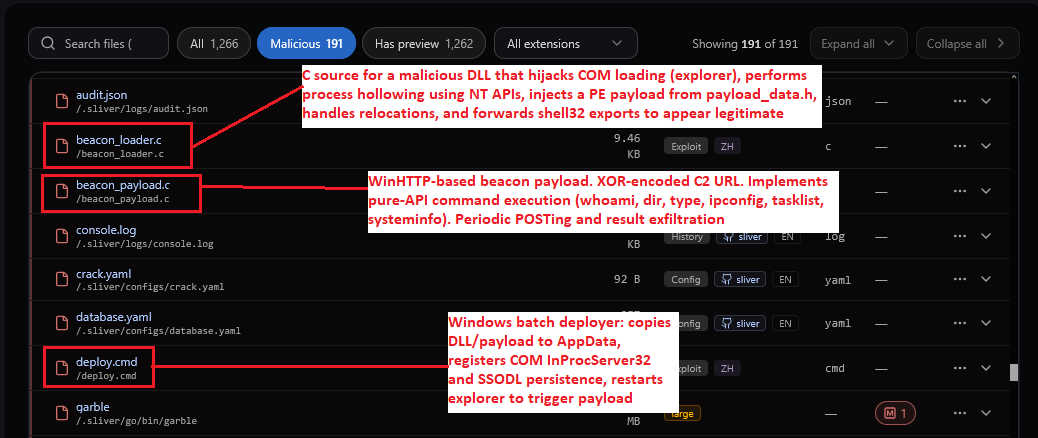
These files contain a Windows persistence and C2 payload toolkit, including a malicious DLL that hijacks COM loading in Explorer and uses process hollowing to inject a PE payload, a WinHTTP-based beacon with an XOR-encoded C2 URL that executes reconnaissance commands and exfiltrates results via periodic POST requests, and a batch deployer that installs the payload into AppData and establishes persistence through COM InProcServer32/SSODL registration, collectively indicating a stealthy persistence mechanism designed to survive reboots and blend in with legitimate Windows processes.
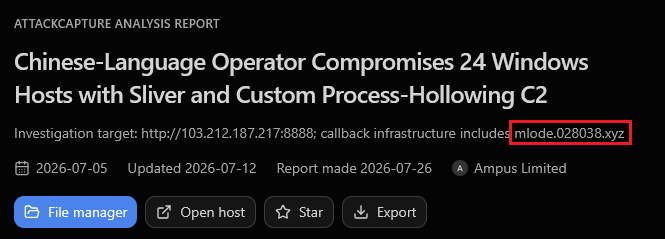
We then search this domain.

Huntio’s code search shows a lot of malicious files, all related to Silver C2, containing commands to generate beacon payloads for C2 and logs indicating offensive usage. A few are listed below:


mlode.028038.xyz operates as an active Sliver C2 team server, used to generate multiple evasive Windows payloads (DLL/EXE/shellcode) and manage HTTPS listeners (ports 443/8443) with anti-fingerprinting features (JARM randomization, OTP enforcement), confirming attacker-controlled C2 infrastructure. As cited in a report by PaloAltoNetworks, North Korean Jumpy Pisces’ intrusion led to Play Ransomware
This finding aligns with a broader trend documented by Unit 42, where Sliver C2 has been observed as a precursor tool to Play ransomware deployment, used by DPRK-linked group Jumpy Pisces for lateral movement and persistent command-and-control ahead of ransomware execution. The presence of Sliver C2 infrastructure and beaconing behavior observed here is consistent with the tactics, techniques, and procedures associated with pre-ransomware staging activity linked to the Play ransomware ecosystem.
PCAP Analysis
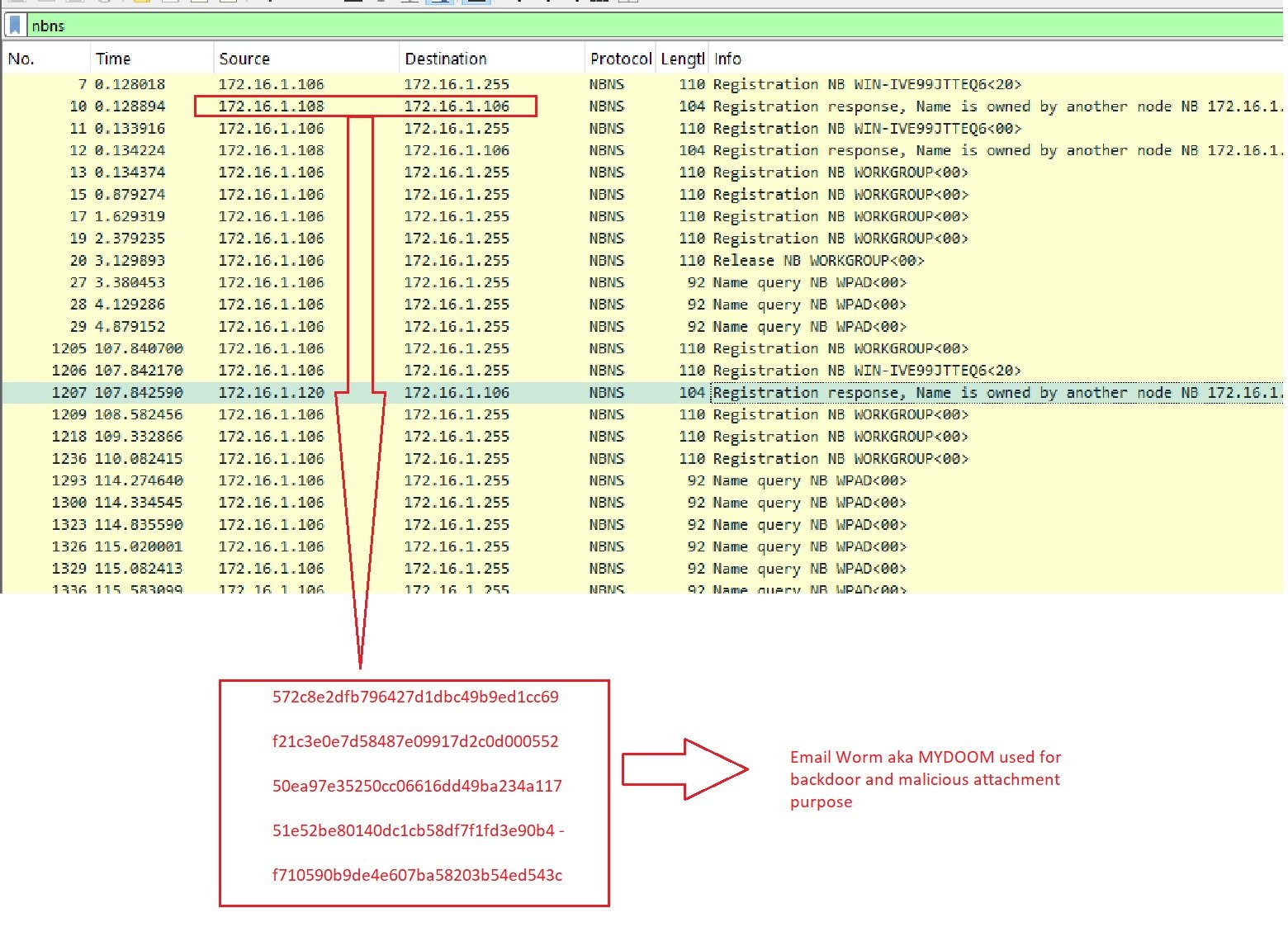
In this NBNS capture from a Play ransomware-affected environment, 172.16.1.106 (LiteON NIC, hostname WIN-IVE99JTTEQ6) exhibits behavior consistent with the reconnaissance and credential access phases of Play's intrusion chain. The most significant indicator is the persistent WPAD<00> name query broadcast storm across packets 27 through 1339. Play operators routinely deploy Responder or Inveigh on a compromised host to answer WPAD queries and capture Net-NTLMv2 hashes from other hosts on the subnet, enabling either offline cracking or NTLM relay attacks against SMB targets (T1557.001). The subnet topology revealed through NBNS conflict responses confirms live hosts at .108, .120, .117, and .118, aligning with T1018 (remote system discovery) and providing the operator a host inventory without generating noisy port scans. The WORKGROUP (non-domain) network environment is a risk factor consistent with Play's documented targeting of flat, poorly segmented networks lacking domain-level defenses. On the cyber kill chain, this traffic maps firmly to the Reconnaissance and Weaponization boundary. The attacker has foothold on .106, is actively profiling the subnet, and is staging WPAD poisoning infrastructure ahead of lateral movement. The WORKGROUP Release at packet 20 and registration churn are consistent with normal Windows NetBIOS behavior and should not be treated as standalone malicious indicators without corroborating C2 or SMB lateral movement traffic in adjacent pcap layers.
| Type | Value | Context |
|---|---|---|
| IP Address | 172.16.1.106 | Primary suspect host, source of all WPAD queries and name registrations |
| IP Address | 172.16.1.108 | Live host confirmed via NBNS |
| IP Address | 172.16.1.120 | Live host confirmed via NBNS |
| IP Address | 172.16.1.117 | Live host confirmed via NBNS |
| IP Address | 172.16.1.118 | Live host confirmed via NBNS |
| Broadcast | 172.16.1.255 | Subnet broadcast, all NBNS queries destined here |
HOST IOCs
| Type | Value | Context |
|---|---|---|
| Hostname | WIN-IVE99JTTEQ6 | NetBIOS name registered by .106, correlate against AD/EDR |
| Workgroup | WORKGROUP | Non-domain environment, no Kerberos hardening |
| MAC Vendor | LiteON (6c:4b:90) | NIC vendor of .106, unmanaged consumer-grade endpoint |
PROTOCOL IOCs
| Type | Value | Context |
|---|---|---|
| Protocol | NBNS / UDP 137 | All malicious activity rides this protocol |
| Query Pattern | WPAD<00> | repeated broadcast 9+ queries with no response, Responder/Inveigh staging indicator |
| Name Type | <20> suffix on WIN-IVE99JTTEQ6 | File server service bit, SMB lateral movement surface |
MITRE ATT&CK
| ID | Technique | Relevance |
|---|---|---|
| T1557.001 | LLMNR/NBT-NS Poisoning | WPAD query storm from .106 |
| T1018 | Remote System Discovery | Host enumeration via conflict responses |
| T1016 | Network Configuration Discovery | WORKGROUP topology revealed via NBNS |
| T1071.002 | Application Layer Protocol: SMB/NetBIOS | NetBIOS used as primary recon channel |
Evaluating Amadey’s Role in Multi-Vector Payload Delivery
The attack begins with a phishing email, and once the user clicks the malicious link, theAmadey Malware-as-a-Service loader is deployed. Amadey drops a hidden desktop.ini file to display fake icons and mimic legitimate-looking processes, keeping the victim distracted while it runs in the background. Meanwhile, it performs a system language discovery check, targeting only non-CIS countries; if the system is set to Russian, Ukrainian, or Belarusian, the malware self-deletes to avoid analysis. A human operator, not an automated process, then manually connects to a Cobalt Strike or Sliver C2 server to exfiltrate data and move laterally across the network. The operator ultimately drops the Play ransomware payload, which encrypts files across the system and leaves a README.txt ransom note on the desktop. The user is left completely locked out of their system, realizing their control is gone the moment they see that file.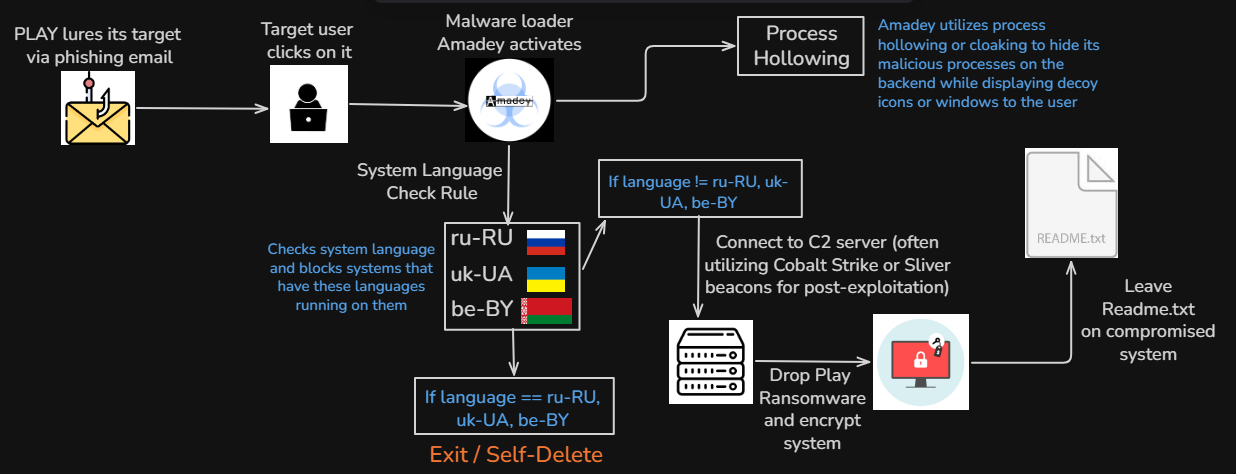
Given the current state of geopolitics, the United States is widely regarded as a strategic adversary of Iran, while Russia remains one of Iran's closest strategic allies. Against this backdrop, the artifacts reveal a pointed pattern. Play's system language exclusion list spares Russia, Ukraine, Belarus, Syria and the wider Middle East, while the United States is deliberately absent from that list and appears repeatedly among confirmed targets. No Iranian systems have been observed in Play's attack history.
Based on this pattern, Akatsuki believes the exclusions are not incidental. The regions spared align closely with Iran's sphere of alliance, while the one major power left exposed is Iran's clearest adversary. Play Ransomware may not be operating purely for profit, the group's targeting choices suggest it is playing a bigger game behind the curtains.

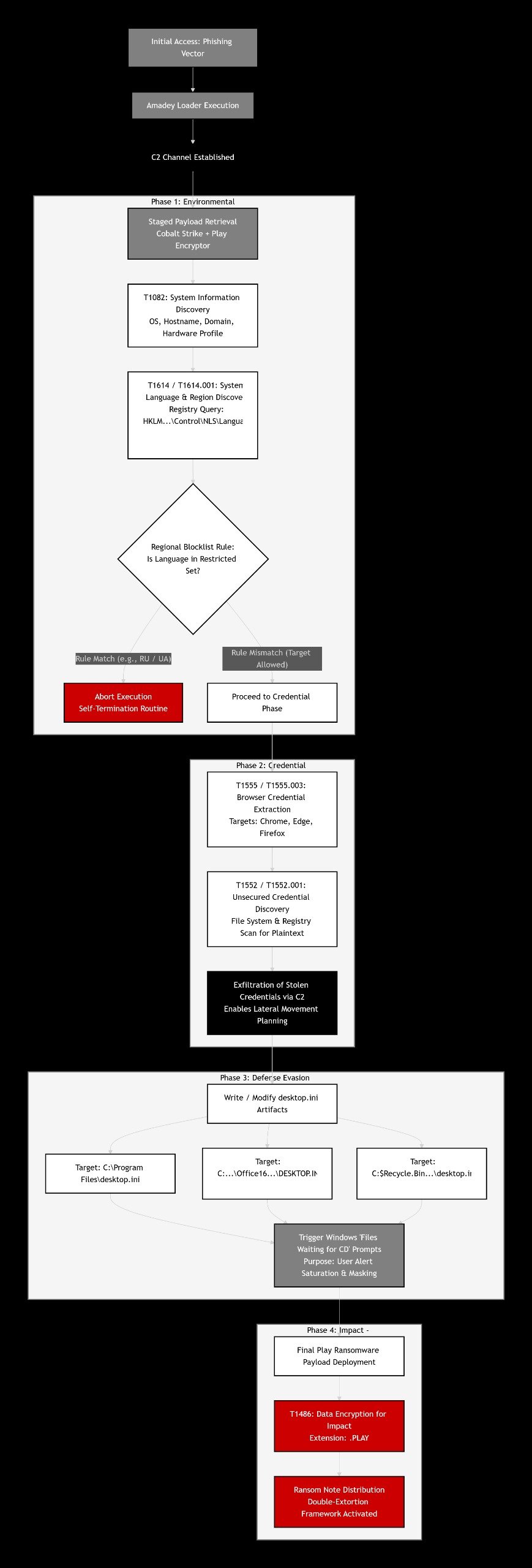
Credential Harvesting via Amadey and Cobalt Strike (TTP)
| Tactic | Technique | ID | Description |
|---|---|---|---|
| Credential Access | Credentials from Password Stores | T1555 | Stealing credentials from password managers and browsers |
| Credential Access | Credentials from Web Browsers | T1555.003 | Specific browser credential theft (Chrome, Edge, etc.) |
| Credential Access | Unsecured Credentials | T1552 | Finding credentials in files, registry, or plaintext |
| Credential Access | Credentials In Files | T1552.001 | Credentials embedded in configuration files, scripts, logs |
| Discovery | System Information Discovery | T1082 | Gathering OS, hardware, and system configuration details |
| Discovery | System Location Discovery | T1614 | Determining victim's geographical location |
| Discovery | System Language Discovery | T1614.001 | Inferring location from system language settings |
Environment Mapping and Drive Enumeration (TTP)
| Tactic | Technique | ID | Description |
|---|---|---|---|
| Discovery | Peripheral Device Discovery | T1120 | Enumerating connected peripherals and devices |
| Discovery | Query Registry | T1012 | Querying Windows Registry for system information |
| Discovery | System Information Discovery | T1082 | Gathering OS, hardware, and system configuration details |
| Discovery | System Location Discovery | T1614 | Determining victim's geographical location |
| Discovery | System Language Discovery | T1614.001 | Inferring location from system language settings |
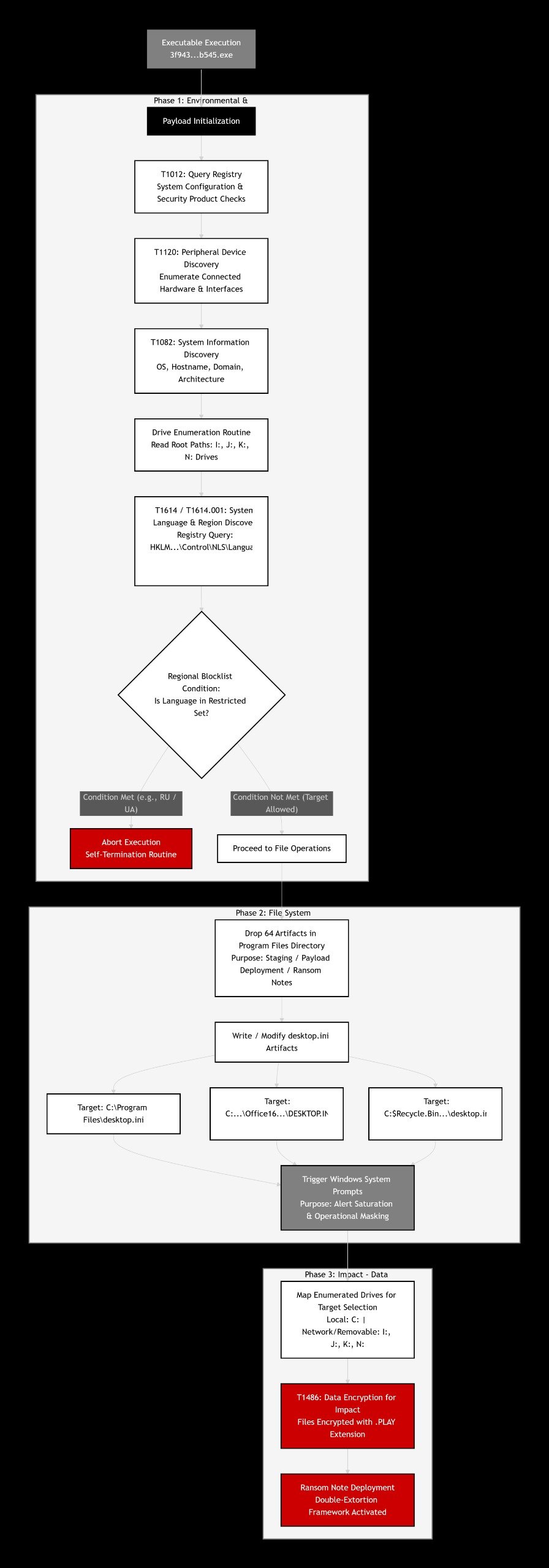
Both samples include T1614 (System Location Discovery) and T1614.001 (System Language Discovery). The presence of these two specific tactics in both samples suggests this is a core, non-negotiable feature of Play's operational security and not a variant-specific addition. This is significant because LockBit 5.0, another major ransomware family, uses execution guidelines from their very own playbook that terminates the malware on Russian-language or Russian-geolocated systems. Play appears to be adopting similar geofencing tactics that check system language and location to avoid running in regions where the operators may not want to operate.
Multi-Stage Intrusion and Credential Harvesting--->The Amadey-Cobalt Strike Play Variant (Static Analysis)
The binary 2026-07-12_0cf3c23415c786210ba8b21f25f8b78a_amadey_cobalt-strike_elex_play.exe
(SHA256: 4508e057faa2e9a38c0c98c9b41ae60d62c06cf698da367709a5627420174f2b) is not a single-purpose ransomware encryptor. It is a multi-function payload containing:
\REGISTRY\MACHINE\SYSTEM\ControlSet001\Control\NLS\Language to enforce a regional block list before proceeding.SHA256 a38d0af3e8d0b3627d1550aed41e5731024d787938c075f5a7a7dac2bbabfd6a, identical hash across both behaviors, confirming the note is hardcoded into the binary, not fetched dynamically.
Summary: This sample represents an operational, multi-stage intrusion chain. The Amadey loader delivers Cobalt Strike for hands-on-keyboard access, Elex for credential theft, and Play for encryption. The behavioral differences between sandbox runs confirm environmental factors influence which code paths execute, but the core malicious intent credential theft, data exfiltration, and encryption is consistent across all runs.
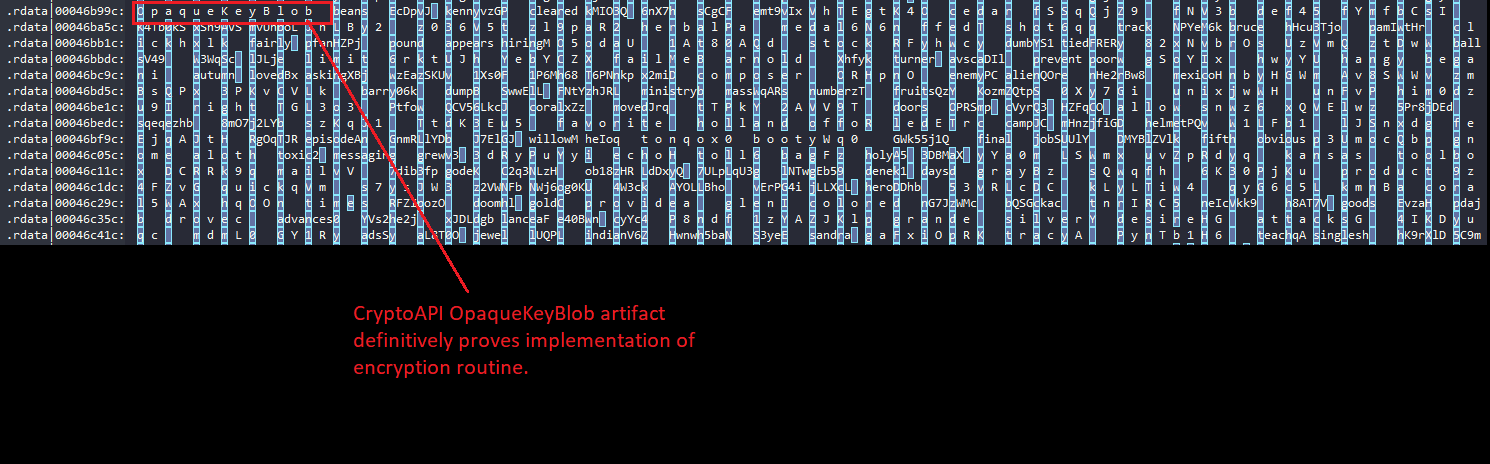
The presence of the OpaqueKeyBlob string within the .rdata section provides unequivocal evidence that the malware utilizes Microsoft's native CryptoAPI (Cryptographic Application Programming Interface) for cryptographic operations. Specifically, OpaqueKeyBlob is a defined structure used by CryptExportKey and CryptImportKey to store and transfer session key material, including associated salt values and initialization vectors. This artifact confirms the implementation of a file-encryption routine, validating the adversary's capability to perform adversarial data destruction (T1486) and execute the ransomware's primary impact objective.
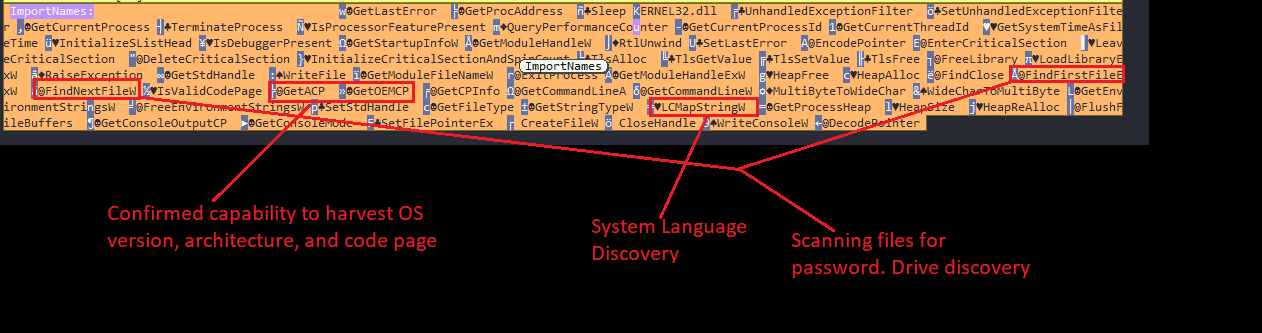
The static analysis of the binary's string table and import address table (IAT) reveals a hardcoded regional blocklist comprising locale identifiers such as ru-RU (Russian), uk-UA (Ukrainian), and be-BY (Belarusian). The presence of the API imports LCMapStringW and LocaleNameToLCID confirms that the malware executes a conditional Geo fencing routine. This routine actively compares the victim system's current language setting against the embedded blocklist. If a match is detected, the execution flow is redirected to a self-termination routine, enforcing an operational execution rule designed to avoid political or legal blowback in restricted geographies.The inclusion of the GetACP (Active Code Page) and GetOEMCP (OEM Code Page) imports, alongside the implied invocation of GetSystemInfo, confirms the malware's capability to harvest foundational system metadata. This reconnaissance function enables the malware to profile the target environment capturing data such as the operating system version, processor architecture, and regional code page settings. This information is utilized by the operator to tailor the attack surface and ensure compatibility with the victim's system prior to executing subsequent payload stages.The import of the file system traversal functions FindFirstFileExW and FindNextFileW substantiates the observed drive enumeration behavior, specifically the targeting of logical volumes \??\I:, J:, K:, and N:. This technique facilitates the comprehensive mapping of all accessible physical and logical drives, including network-mapped storage and removable media. By establishing a complete inventory of available storage devices, the malware maximizes the potential blast radius of its encryption routine, ensuring no accessible data is overlooked during the impact phase.
Conclusion
We traced a single hash through three pivots to a Cobalt Strike server on Tencent with 1,688 exploit and credential theft scripts, a Sliver host on Ampus with port 31337 open, and a live team server generating evasive Windows payloads, all found through open directories without touching a victim network. Play's unhardened leak site exposed faq.php via a missing Referrer-Policy, letting us map the four to eight day negotiation window between listing and publication from outside. A foothold on 172.16.1.106 used WPAD broadcasts to map hosts without port scanning, leading to one binary carrying Amadey, Cobalt Strike, Elex and the Play encryptor that writes desktop.ini markers, enumerates 23 drives, and encrypts with a baked-in ransom note, meaning egress blocking and network signatures cannot stop impact and detection must happen on the host at execution. Every sample checks the locale key and exits on ru-RU, uk-UA or be-BY, which we treat as a hypothesis needing longer victimology data. Defenders should close internet-facing RDP, VPN, FortiOS and Exchange, enforce phishing-resistant MFA, disable NBT-NS and LLMNR, segment flat networks, and treat data exposure separately from recovery since stolen files cannot be bought back. Play rotates onion infrastructure yearly in pairs, so when address four dies expect two replacements with the same nginx fingerprint.
Need help hunting this activity in your environment?
Engage Akatsuki